
Water Stewardship
Implementing micro-drip networks, soil moisture analytics, and groundwater recharge basins in the Wasco basin.
Smart Drip Irrigation &
Aquifer Management
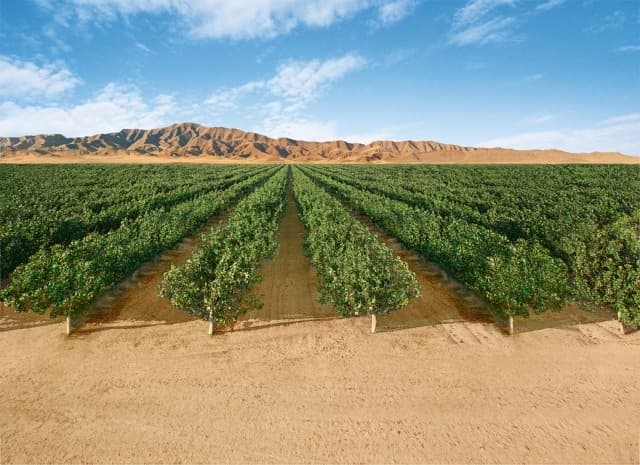
Water is California's most vital resource. At Primex Farms, we combat drought and preserve water tables by converting 100% of our active acreage to precision micro-drip networks. This supplies water directly to tree root structures, eliminating evaporation loss. Our water engineers calculate irrigation schedules using daily Evapotranspiration (ETc) indices sourced from the California Irrigation Management Information System (CIMIS), matching soil water depletion with accurate supply.
To calibrate our electronic moisture probes, we utilize weighing lysimeters installed in representative orchard blocks. These instruments directly measure the water lost by the soil and crop via transpiration, allowing us to build highly accurate irrigation algorithms. The electronic sensors measure soil tension and volumetric water content at depths of 12, 24, 36, and 48 inches, ensuring that water does not leach below the active root zone where it would be wasted.
In addition to minimizing water use, we participate in proactive groundwater banking. During years with high Sierra Nevada snowpack runoff, we divert surplus surface canal allocations into our unlined recharge cells. These basins hold water, allowing it to percolate into the Kern County groundwater subbasin, recharging the common pool aquifer that supports both agriculture and local municipal water systems.
Water Engineering Metrics
Precision Micro-Drip
High-density drip emitters supply water directly to rootzones. This reduces average water consumption by over 30% compared to sprinkler systems.
Soil Probe Telemetry
Continuous wireless sensors monitor soil saturation levels at varying depths, helping our growers irrigate only when necessary.
SGMA Basin Integrity
We actively collaborate with Kern County water districts to store and filter winter canal runoff, recharging vital local aquifers.
Kern County Water History & Infrastructure
The history of water in Kern County is inseparable from the history of California agriculture itself. The Kern River, flowing westward from the Sierra Nevada into the southern San Joaquin Valley, was the region's original freshwater lifeline — supporting the Yokuts people for thousands of years before European contact and providing the hydrological foundation for the agricultural development that began with Spanish mission irrigation in the late 18th century. By the 1870s, irrigation entrepreneurs including James Ben Ali Haggin and Lloyd Tevis were constructing the elaborate network of Kern River diversion canals that would irrigate hundreds of thousands of acres of valley floor and transform what had been semi-arid rangeland into some of the most productive agricultural land on earth. The Kern Delta Water District, Buena Vista Water Storage District, and Kern River Water Rights — the institutional frameworks within which Primex Farms now operates — trace their legal foundations to water rights adjudicated in the landmark 1880 California Supreme Court decision in Lux v. Haggin, which established California's hybrid doctrine of riparian rights and appropriative rights that remains the foundation of California surface water law today.
The construction of the State Water Project (SWP) in the 1960s fundamentally transformed water supply to the southern San Joaquin Valley. The SWP's California Aqueduct — a 444-mile concrete-lined channel that carries water from the Sacramento-San Joaquin Delta southward to Kern County and beyond — delivers State Water Project allocations to the Kern County Water Agency (KCWA) and its member units, including the Buena Vista Water Storage District (BVWSD) that supplies Primex Farms with surface water during years of adequate SWP allocation. BVWSD holds a SWP Table A contract entitlement of approximately 74,200 acre-feet per year — a theoretical maximum that has never been fully delivered, because SWP deliveries are curtailed during drought years when reservoir storage and delta water quality constraints limit pumping from the Sacramento-San Joaquin Delta. Over the period 2000–2024, average annual SWP delivery to BVWSD has been approximately 42% of Table A contract amount — a reliability level that forces BVWSD member farms including Primex Farms to maintain significant groundwater pumping capacity for drought-year supply security.
The canal infrastructure that delivers BVWSD water to Primex Farms' property is itself a remarkable engineering achievement. The main supply canal — a concrete-lined earthen channel with a design flow capacity of 120 cubic feet per second — runs within 1.2 miles of Primex Farms' western property boundary, connected to our on-farm distribution system by a gated turnout structure that allows us to divert our allocated share of canal flow into a 4.8-acre retention pond on our property. This retention pond serves multiple functions: it provides a buffer between the intermittent canal delivery schedule (typically offered in 12–24 hour delivery windows several days per week during the irrigation season) and our continuous drip system demand, it allows solids in the canal water to settle before the water enters our drip system filters, and it serves as our primary on-farm emergency water reserve during pump maintenance periods or short-duration supply interruptions.
Our groundwater supply system consists of three production wells drilled to depths of 320, 380, and 445 feet — depths necessary to reach the most productive saturated zones of the Kern County Subbasin's unconfined aquifer in our property location. The wells are equipped with vertical turbine pumps rated at 1,800, 2,200, and 1,600 gallons per minute (gpm) respectively, powered by 150 hp, 200 hp, and 125 hp electric motors. Total pumping capacity of approximately 5,600 gpm (12.5 cubic feet per second) provides more than adequate capacity to meet our peak irrigation demand of approximately 3,800 gpm on the hottest days of summer. Static water level in our wells — the depth to the water table when the pumps are not running — has changed significantly over our operational history: in 2001 when the first well was drilled, static water level was approximately 90 feet below surface; by 2015 it had declined to approximately 140 feet; by 2022 (the end of a severe multi-year drought) it had reached a low of 167 feet, before recovering to approximately 148 feet following the exceptional 2022–23 wet winter. This 65-foot decline over 22 years — driven by regional overdraft across Kern County agriculture — is precisely the aquifer depletion crisis that SGMA was designed to address and that Primex Farms is committed to helping reverse.
The geology of the Kern County Subbasin creates unique opportunities and challenges for groundwater management. The subbasin is characterized by a thick sequence of unconsolidated alluvial sediments — gravel, sand, silt, and clay deposited by the Kern River over millions of years — that can store enormous volumes of water when saturated. The transmissivity of these sediments (their ability to transmit water horizontally under a hydraulic gradient) is very high in the coarser gravel layers — making them excellent aquifer zones — but lower in the interbedded clay-rich strata that can impede vertical movement of water between aquifer zones. This layered geology means that aquifer recharge from surface spreading requires careful siting in areas where permeable sand and gravel pathways exist between the surface and the target saturated zone, and that the effectiveness of our on-farm recharge basin depends critically on whether the underlying geology provides a high-permeability conduit to the productive aquifer depths where our well pumps draw water. Hydrogeological studies commissioned by the Kern Groundwater Authority's SGMA planning process have mapped the permeability distribution of the subbasin in considerable detail, and Primex Farms has used this publicly available mapping to verify that our recharge basin is positioned over a favorable high-permeability corridor — a factor that explains our measured percolation rates of 0.8–1.4 feet per day during active recharge events.
Water Banking Economics & SGMA Compliance Planning
Water banking — the practice of storing excess surface water in aquifers during wet years for later extraction during dry years — has become the cornerstone of long-term water security strategy for Kern County agriculture. The Kern Water Bank (KWB), developed by the Kern County Water Agency in the 1990s on former Buena Vista Lake bed land near Bakersfield, is the largest water bank in California and one of the largest in the world. Its capacity to store approximately 500,000 acre-feet of water in the saturated zone of the highly permeable ancient lake bed sediments allows utilities, water districts, and private users to deposit surplus SWP water during high-delivery years and withdraw it during drought years — effectively creating a drought buffer that smooths the extreme supply variability of the SWP across the agricultural calendar.
Primex Farms accesses the Kern Water Bank through our BVWSD membership, which entitles us to a proportional share of BVWSD's KWB storage account. When BVWSD receives above-average SWP allocations in a wet year, it directs surplus water into the KWB, crediting the stored volume proportionally to member accounts. Primex Farms can then 'withdraw' from our credited balance in subsequent years by receiving groundwater pumped from KWB's extraction wells — delivered to us through the BVWSD canal system as if it were surface water. The economic value of this arrangement became starkly apparent during the 2020–21 drought year, when our KWB balance of approximately 420 acre-feet allowed us to supplement an inadequate SWP allocation and maintain full orchard irrigation without purchasing spot market water at prevailing drought prices of $450–580 per acre-foot — a cost avoidance of approximately $190,000–$244,000 in that single season.
Beyond the Kern Water Bank, Primex Farms is exploring opportunities to develop private water banking arrangements with neighboring landowners who have permeable soils but insufficient production to justify dedicated recharge infrastructure. Under a private water banking agreement, Primex Farms would fund the construction of a recharge basin on the neighboring property, receive a proportional share of the recharge credits generated under the KGA's SGMA accounting system, and use those credits to offset our own extraction — effectively expanding our recharge capacity beyond our own property boundaries. The legality and practicality of such arrangements are being evaluated in consultation with KGA staff and water rights counsel, as SGMA implementation has created new legal frameworks for multi-party recharge projects that did not exist before 2014.
SGMA's requirement that the Kern County Subbasin achieve 'sustainable' groundwater conditions by 2040 translates, in practical terms, to a multi-decade trajectory of gradually declining permitted extraction levels and increasing groundwater replenishment obligations for all large users including Primex Farms. The Kern Groundwater Authority's adopted Groundwater Sustainability Plan projects that total subbasin extraction must decline by approximately 320,000 acre-feet per year between 2022 and 2040 — achieved through a combination of efficiency improvements by existing users, land fallowing programs, managed aquifer recharge expansion, and the natural attrition of some water-intensive annual crop production in favor of perennial tree crops that can tolerate moderate stress events without total crop loss. Primex Farms' long-term water demand projections, modeled at various efficiency improvement scenarios, show that our 2040 per-acre consumption can be reduced to the 3.6–3.8 acre-foot range (from our current 4.1–4.4 acre-foot range) through a combination of continued SDI system optimization, crop-level water stress tolerance management during off-peak growth stages, and partial adoption of regulated deficit irrigation protocols during the pre-harvest period.
The socioeconomic implications of SGMA for farming communities like Wasco are deeply complex and a subject of active policy debate. Reducing groundwater extraction by the amounts required to achieve sustainability will inevitably mean that some agricultural land currently in production will need to be fallowed or converted to less water-intensive uses — a transition that will affect farm employment, local tax revenues, and the social fabric of communities whose identity and economy are built around agriculture. Primex Farms participates actively in KGA governance to advocate for transition timelines and mitigation programs that are economically workable for commercial pistachio operations, which face a unique constraint: unlike annual crops that can be fallowed one year and replanted the next without major economic loss, pistachio orchards represent 25–35 years of compound investment that cannot be abandoned temporarily and restarted without destroying the entire capital investment. Our position in SGMA advocacy is that extraction reductions must be phased gradually and predictably, allowing permanent crop producers to adapt their water supply portfolios before facing mandatory curtailment.
Looking ahead over the next 15 years, Primex Farms' water stewardship roadmap includes five specific capital investments and program commitments: (1) expansion of our on-farm recharge basin from 8 to 14 acres by 2026, utilizing a winter flood water delivery contract with BVWSD that provides recharge water at a subsidized rate during high-flow years; (2) installation of an additional 20 soil moisture monitoring stations across our older orchard blocks by 2027, enabling block-level irrigation scheduling refinement that our modeling projects will reduce per-block consumption by 8–12% in those areas; (3) conversion of our remaining 180 acres of surface-drip irrigated leased ground to subsurface drip by 2028, eliminating the last remaining source of surface evaporation in our irrigation infrastructure; (4) completion of a five-year soil water balance study in collaboration with UC Cooperative Extension that will generate published irrigation management guidelines for pistachio producers in the Kern County Subbasin; and (5) achievement of the Kern County Water Agency's 'Water Champion' recognition tier by 2030, a program that certifies agricultural producers who have demonstrated measurable water use reduction of at least 20% per unit of yield relative to their district baseline — a target that our efficiency trajectory puts within reach by 2029.