

About Primex Farms
Cultivating California's finest pistachios with a legacy of quality, sustainability, and agricultural excellence.
Rooted in
California's Central Valley
Established with a passion for agriculture, Primex Farms LLC has grown into a premier producer and processor of high-quality pistachios, almonds, and tree nuts. Located in the fertile heart of California at 16070 Wildwood Rd, Wasco, our orchards benefit from the perfect climate and soil conditions. Over the years, we have scaled our operations from a local growing collective to a vertically integrated agricultural enterprise that oversees the lifecycle of the pistachio nut from raw seed to international shipment.
Our Wasco headquarters serves as the central hub of our agricultural ecosystem. Here, the unique topography of the southern San Joaquin Valley—characterized by dry, hot summers and cool, foggy winters—provides the exact chilling hours required for pistachio trees to break dormancy in the spring and thrive. The deep, alluvial soil profiles in our orchards hold nutrients exceptionally well, which we support using biological composting and zero-tillage cover cropping techniques to maintain soil biology.
Led by a dedicated team of agricultural professionals, we control every step of the process—from cultivation to advanced optical sorting at our state-of-the-art facility. Follow our journey on Instagram @primex.usa to see how we bring the best of California to our global partners. We are deeply committed to sustainable growing practices, resource-efficient harvesting, and local employment opportunities.
Quality
Farming
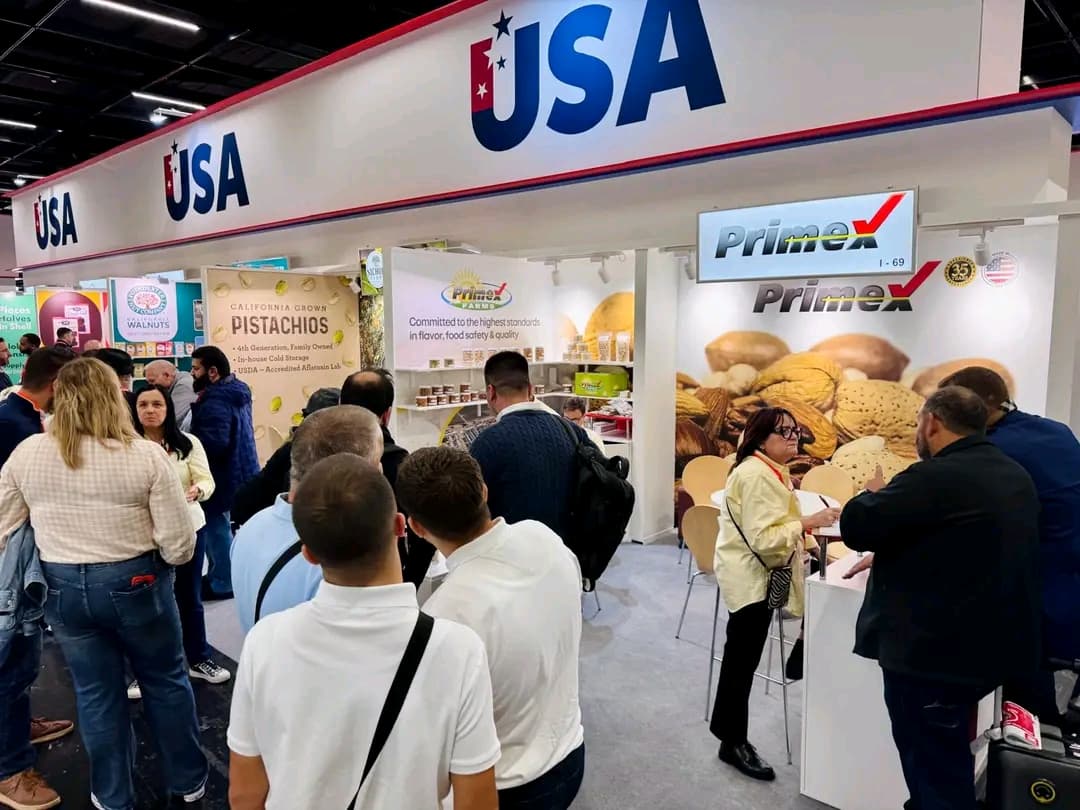
Key Milestones & Growth
Orchard Roots
First 1,200 acres of pistachio rootstocks planted in Kern County soil, utilizing advanced root breeding.
Wasco Processing
Completed our flagship 100,000 sq. ft. hulling and drying facility to control processing directly on-site.
Drip Conversion
Replaced 100% of standard flood irrigation with precision subsurface micro-drip emitters to save water.
Solar Integration
Built our 2.1MW solar array, supplying over 85% of our processing plant's peak seasonal power requirements.
Optical Grading
Integrated state-of-the-art optical sorters for high-speed color, structural, and pathogen screening.
Pistachio Lifecycle & Cultivation Insights
Understanding Alternate Bearing Cycles
Pistachios are characterized by alternate bearing, an inherent physiological cycle where the trees yield heavily in one year ("on-crop" year) and produce minimally the following year ("off-crop" year). During the off-crop year, the tree redirects its carbon reserves into root growth, wood strength, and bud development for the next season's bloom.
At Primex Farms, our agronomists utilize specific pruning schedules and nutrient application budgets to smooth out these fluctuations, ensuring stable year-over-year production volumes for our contract wholesale clients.
Kernel Development and Chilling Hours
Pistachios require approximately 700 to 1,000 cumulative hours below 45°F during the winter dormancy period. Without adequate winter chill, flower buds open unevenly, leading to reduced pollination efficiency and a higher percentage of blank (empty) shells.
Our location in Wasco, California offers the ideal microclimatic window, combining clean valley air currents with fog patterns that insulate orchards, preserving soil coolness and locking in early nutrient-retention cycles.
Our Core Values
Excellence
We never compromise on quality. Our rigorous processing standards ensure top-tier agricultural products.
Sustainability
We employ water-efficient irrigation and eco-friendly farming practices to protect California's environment.
Community
We believe in fostering strong relationships with our workers, local community, and global partners.
Meet Our Leadership
.jpeg&w=3840&q=75)
Mary Manriquez
HR & Administration
.jpeg&w=3840&q=75)
Bob Engleman
Operations Lead
.jpeg&w=3840&q=75)
Rogelio Tapia
Orchard Management
.jpeg&w=3840&q=75)
Diana DeVera
Processing & Distribution
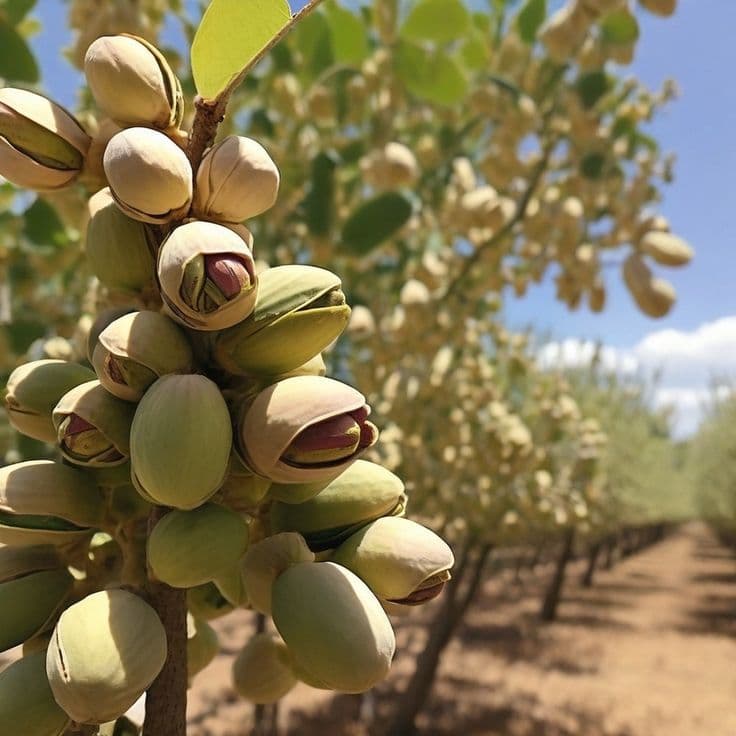
From Orchard to
Global Markets
Orchard Cultivation
Expert farming in Wasco, California with sustainable irrigation.
Precision Harvesting
Harvested at peak ripeness to lock in flavor and size.
Optical Sorting
State-of-the-art tech guarantees only the finest nuts pass our standards.
Wholesale Distribution
Packaged securely for bulk international and domestic shipping.
The Science Behind Our Terroir
Wasco, located in the southern end of California's San Joaquin Valley in Kern County, sits at approximately 331 feet above sea level within a broad, tectonically active alluvial basin formed over millions of years of geological deposition. The soils beneath Primex Farms' orchards are classified primarily as Milham loam and Bakersfield sandy loam — deep, well-draining profiles that were laid down by ancient river systems flowing westward from the Sierra Nevada. These soils offer exceptional drainage while retaining just enough moisture at the 18–36 inch depth to provide supplemental water to pistachio root systems during dry spells, reducing the burden on irrigation infrastructure.
The climate of the southern San Joaquin Valley is classified as a BSk semi-arid steppe under the Köppen climate classification, characterized by extremely hot, dry summers — often exceeding 105°F in July and August — and cool, wet winters that rarely drop below 26°F. This thermal regime is almost perfectly calibrated to the biological demands of Pistacia vera, the cultivated pistachio. Pistachios are one of the very few tree nuts that require intense summer heat to properly fill their shells, a process driven by soluble carbohydrate translocation from leaf canopy to developing kernels during the critical August–September window. At the same time, they need sufficient winter chill hours — typically 800 to 1,000 hours below 45°F — to break dormancy uniformly in spring. Wasco reliably accumulates between 900 and 1,200 chill hours per season, making it ideal.
The San Joaquin Valley's characteristic tule fog, which blankets the valley floor from November through February, plays an important role in moderating winter temperatures and ensuring that chill hour accumulation occurs gradually rather than in damaging frost spikes. This slow, steady chilling ensures uniform bud break across entire orchards in late February and early March, so that male pollen release from Peters and Randy pollinizer trees synchronizes perfectly with female pistillate flower receptivity on Kerman trees — the commercial backbone of California pistachio production. Without fog moderation, inconsistent chilling would cause erratic bloom timing, reducing pollination rates by 15–30% and significantly cutting yield.
Spring winds from the northwest typically arrive in March and April, serving as a natural pollination engine as male catkins shed pollen in enormous clouds that drift across rows of female trees. Primex Farms' orchard layout — with pollinizer rows positioned at calculated intervals of 1:8 or 1:12 male-to-female ratios and oriented perpendicular to prevailing spring wind corridors — maximizes wind-borne pollen distribution across the entire orchard canopy without the need for artificial pollen supplementation. This design decision, informed by decades of observational data gathered by our agronomists, consistently achieves pollination rates above 92%, translating directly into the dense, well-filled kernel sets that buyers recognize as the Primex standard.
Water management in this semi-arid climate is both an art and a science. The valley's annual rainfall averages only 6.5 inches, falling almost entirely between November and March, providing minimal in-season moisture. All crop water demand — approximately 4.2 to 4.8 acre-feet per acre per season for mature pistachio orchards — must be met through irrigation. Primex Farms' buried drip irrigation systems deliver water directly to the root zone at controlled rates calibrated weekly against California Department of Food and Agriculture ETo (evapotranspiration reference) data broadcast from CIMIS weather stations located within three miles of our orchards. This precision ensures that crops never experience water stress during the critical nut-sizing window of May through July, while simultaneously avoiding excessive vegetative growth in August that would divert energy away from shell filling.
The alkaline soil pH of 7.5 to 8.2 found across Kern County's alluvial deposits is another factor that makes pistachio cultivation uniquely advantageous here. Unlike most nut crops, pistachios are highly tolerant of alkalinity and can mobilize iron and zinc from calcareous soils that would render almonds or walnuts chlorotic. The UCB-1 rootstock — a Pistacia atlantica × Pistacia integerrima hybrid used almost universally across California's commercial pistachio orchards including Primex Farms — thrives in these conditions and provides a robust anchor system that can penetrate hardpan layers to access deep moisture reserves. UCB-1's tolerance for Phytophthora root rot, Verticillium wilt, and moderate salinity (up to 6 dS/m) makes it a resilient platform for long-lived, productive orchards, with commercial lifespans routinely exceeding 30–40 years when properly managed.
Agricultural Philosophy & Land Stewardship
At Primex Farms, we approach land stewardship with the conviction that a healthy ecosystem is the foundation of a commercially successful operation. This belief shapes every management decision we make, from the species of cover crops we sow between rows in October to the microbial inoculants we introduce at transplanting to populate young root systems with beneficial mycorrhizal fungi. Our philosophy integrates traditional California dryland farming wisdom with the latest findings from UC Cooperative Extension research trials, creating a management system that is simultaneously rigorous, evidence-based, and ecologically sensitive.
Central to our approach is the concept of building soil organic matter over time rather than mining it for short-term yield. When Primex Farms' original orchards were established in the early 2000s, the Milham loam soils averaged approximately 0.7–0.9% organic matter — typical for heavily cultivated Kern County farmland. Through 20 years of consistent cover cropping with legume mixes including crimson clover, common vetch, and hairy vetch, combined with complete incorporation of orchard floor biomass and minimal tillage practices, our oldest orchard blocks now test at 1.4–1.8% organic matter. While those numbers may appear modest in absolute terms, each 0.1% gain in organic matter per acre represents the sequestration of approximately 2,000 pounds of carbon and significantly improves water-holding capacity, nutrient availability, and beneficial soil microbial biomass.
Integrated Pest Management (IPM) is another pillar of our philosophy. Rather than applying pesticide calendar sprays regardless of pest pressure, our certified pest control advisors (PCAs) walk orchard rows weekly during the growing season, performing systematic assessments of key pistachio pests including Navel Orangeworm (NOW), leaffooted bug, and Botryosphaeria fungi. Action thresholds — the pest population levels above which intervention becomes economically justified — guide every spray decision. In years of low NOW pressure, we may make as few as two targeted interventions in the entire season, compared with an untargeted conventional program that might schedule six or more sprays. This restraint reduces input costs, preserves populations of beneficial insects including Trichogramma parasitic wasps and green lacewings, and maintains the biological equilibrium that keeps secondary pests from exploding.
Nutrient management at Primex Farms is guided by annual leaf tissue analysis and soil sampling conducted at a minimum of one composite sample per 20 acres of orchard. These analyses provide precise data on nitrogen, phosphorus, potassium, zinc, boron, and manganese status across different soil types and orchard ages. Our agronomists use these results alongside yield history maps to develop block-specific fertilizer programs delivered through the drip irrigation system — a practice known as fertigation. Nitrogen, for example, is applied in split doses timed to match the crop's physiological demand curve: a small preplant application in early spring to support canopy leafing out, a larger midseason application in May–June to fuel kernel development, and no nitrogen after July 15 to avoid excessive shoot growth and to encourage the onset of hull split. This precision has allowed us to reduce total nitrogen application rates by 18% compared with standard industry recommendations while maintaining or improving yield and kernel fill.
We also invest heavily in pollinator habitat. Approximately 4.7 acres of our farmland are dedicated to insectary plantings — strips of flowering native plants including California phacelia, globe gilia, and native buckwheat species — positioned at the headlands and along access roads of our orchards. These plantings serve multiple ecological functions: they provide nectar and pollen for beneficial insects throughout the season, act as windbreaks that reduce soil erosion during spring winds, and create overwintering habitat for ground-nesting bees and predatory beetles. Monitoring stations within the insectary strips consistently record 12–18 native bee species during peak bloom, a diversity that supports robust natural pest suppression across adjacent orchard blocks.
Water conservation is inseparable from our agricultural philosophy. Primex Farms has transitioned all irrigated acres to subsurface drip irrigation (SDI), with emitters placed 24 inches below the soil surface at 18-inch in-row spacing. SDI systems eliminate surface evaporation entirely — a major source of water loss in conventional surface-irrigated or overhead-sprinkled systems — and deliver water precisely to the active root zone where it can be taken up rather than lost to runoff, deep percolation, or soil evaporation. Our SDI systems operate at pressures between 12 and 18 PSI, monitored continuously by pressure transducers at system manifolds, ensuring uniform distribution uniformity above 95% even on days when Wasco's summer heat reaches 108°F. Water use efficiency, measured as yield per acre-foot of water applied, has improved by 23% over the past eight years at Primex Farms as SDI coverage has expanded.
Vertical Integration: Why It Matters
Vertical integration in agriculture means owning and controlling every link in the supply chain from orchard cultivation through final delivery to the buyer. Primex Farms has built this capability deliberately over two decades, driven by our founders' belief that quality cannot be guaranteed at a distance — it must be cultivated, monitored, and verified at every stage. The result is a system where a single decision-maker can trace any finished pallet of pistachios back to the specific orchard block where those trees were harvested, the equipment that shook them from the branches, the bins they were transported in, the hour they entered the huller, the temperatures they experienced in the dryer, and the optical sorter passes that certified their grade. That level of end-to-end traceability is simply not possible when operations are fragmented across multiple contractors.
Our vertical integration begins in the nursery. Unlike operations that purchase bare-root trees from independent nurseries, Primex Farms produces a portion of its replacement and expansion planting stock in-house, using UCB-1 rootstock seeds germinated under controlled greenhouse conditions, then bench-grafted with certified, virus-indexed Kerman and Randy scion wood. This control over the nursery stage ensures that every tree installed in our orchards has a documented parentage and can be assigned a certified variety designation — critical documentation for organic certifications and for buyers in markets that require cultivar verification on certificates of origin.
Post-harvest, vertical integration means that Primex Farms' mechanical harvest equipment — our fleet of Exact Harvest shakers, Savage windrow pickups, and harvest transport trailers — is owned, maintained, and operated entirely by our own staff, trained to Primex's internal operating standards. Harvest windows in the pistachio industry are narrow — typically 14 to 21 days — and getting the timing right is critical because early harvest results in poor hull split rates and immature kernels, while delayed harvest leads to hull stain, elevated aflatoxin risk from Aspergillus contamination in split nuts, and increased losses to Navel Orangeworm secondary infestation. Our harvest scheduling team monitors hull split progress daily using transect sampling across all orchard blocks and targets the harvest of each block when split rates reach 75–85%, the industry-optimum range. Because we own our equipment, we are never waiting for a custom harvester to finish a neighboring farm — we move when the crop dictates.
The integration of our processing facility into the same operational umbrella as our orchards allows product to move from harvest to huller within hours — a timeline far faster than the 12–24 hour delays common when growers must transport product to a co-op or custom processor. This speed is agronomically significant: green, un-hulled pistachios contain high concentrations of organic acids in the hull mesocarp, and prolonged contact of the hull with the shell and kernel promotes staining, off-flavors, and elevated moisture that creates favorable conditions for mold. By hulling within four hours of harvest for same-day blocks and within eight hours for blocks harvested later in the day, Primex Farms consistently achieves a lower hull-stain rate and cleaner shell color than industry average, measurable outcomes that directly influence our optical sorter pass-through rates and our finished product's market premium.
On the distribution side, vertical integration gives Primex Farms the flexibility to respond rapidly to buyer specifications. Because we manage our own cold storage, our own packaging equipment, and our own quality control laboratory, we can fulfill custom packaging orders, adjust moisture levels for specific export markets, or add re-roasting parameters for a food-service client without coordinating logistics across multiple vendors — changes that in a fragmented supply chain would take weeks are accomplished in days. This agility has proven especially valuable in our international business, where different markets have specific requirements: European Union buyers expect 10–11% moisture on natural-in-shell product, while Middle Eastern buyers typically request 9–10% for longer ambient shelf life, and Asian confectionery processors demand precisely sized kernel grades that require secondary sorting runs not typically offered by co-op processors.
Frequently Asked Questions
How long have pistachios been grown at Primex Farms?
Primex Farms planted its first commercial pistachio orchard blocks in 2001 in Wasco, California. Our earliest trees are now entering their 25th producing season — an age at which pistachio trees, properly managed, are historically among the most productive in their orchard lives. We have continued to expand plantings in multiple phases, with our most recent block additions occurring between 2018 and 2023, giving us a diversified age distribution across our total acreage that stabilizes our annual production despite the pistachio industry's well-known alternate-bearing cycle.
What pistachio varieties does Primex Farms grow?
Our primary commercial variety is Kerman, the dominant California pistachio cultivar, prized for its large kernel size, high split rate, and excellent flavor profile. Kerman trees are dioecious females that require pollination from male trees; we use Peters and Randy pollinizer varieties in ratios determined by block layout and prevailing wind direction. All trees are grafted onto UCB-1 rootstock (Pistacia atlantica × integerrima hybrid), which provides superior soil adaptability, salinity tolerance, and Phytophthora resistance compared with older Pistacia terebinthus rootstocks.
Is Primex Farms certified organic?
A portion of our acreage is managed under USDA National Organic Program (NOP) standards and has completed the required 36-month transition period. Our organic certification is maintained annually through a CDFA-accredited third-party certifying agent. Our conventional acreage is managed under California Department of Pesticide Regulation (CDPR) permit requirements and follows Good Agricultural Practices (GAP) standards verified by third-party audits. We are happy to provide current organic certificates and audit reports to buyers upon request.
Does Primex Farms sell directly to the public?
Primex Farms' primary business is wholesale and bulk distribution to food manufacturers, importers, distributors, and retail chains. However, we do offer retail quantities through our online shop for consumers who wish to experience our product directly. Our minimum wholesale order is 1,000 pounds per SKU, with full LTL and FTL freight options available ex-Wasco, CA. Customers interested in high-volume supply agreements are encouraged to contact our sales team to discuss annual contract pricing, shipment scheduling, and product specifications.
What makes California pistachios different from Iranian or Turkish varieties?
California pistachios, including Primex Farms' Kerman variety, are generally characterized by larger kernel size (fewer count per ounce), a higher natural split rate — typically 85–93% depending on the season — and a cleaner, milder flavor profile compared with many Middle Eastern varieties. California's semi-arid climate and premium irrigation management produce consistent, predictable crop quality year over year, unlike regions subject to more variable rainfall patterns. California also benefits from some of the most rigorous food safety regulatory frameworks in the world, including mandatory Pasteurization under USDA rule (21 C.F.R. § 113) and comprehensive aflatoxin testing programs that ensure food safety standards are well above international Codex Alimentarius minimums.
How does Primex Farms handle the alternate-bearing cycle?
Pistachios are inherently biennial in their bearing habit — 'on years' produce heavy crops while 'off years' produce light ones, a cycle driven by the depletion of the tree's carbohydrate reserves during a heavy crop year. Primex Farms manages this cycle through several strategies: aggressive thinning in heavy-on years to reduce the depletion effect, precise nitrogen and carbohydrate management through strategic pre-harvest irrigation cutoffs and fall fertilization, and diversification of block planting dates so that orchard age distribution is staggered — older blocks tend to bear on different cycles than newer ones, partially smoothing the portfolio-level production swing. Despite these measures, a 20–40% variance between on and off years is considered normal in the industry.