
Orchard Management
Expert, year-round orchard care rooted in decades of California Central Valley farming expertise — from soil preparation to peak-season harvest.
Precision Farming from
Root to Canopy
Our orchard management program covers every lifecycle stage of the pistachio tree. We manage soil nutrition, irrigation scheduling, canopy pruning, biological pest control, and micro-climate monitoring to maximize yield potential every season. Grounded in Wasco, California, our team works with local geological structures to optimize fertilizer efficiency and soil health.
A core component of our cultivation strategy is soil biological restoration. Instead of relying solely on synthetic chemical fertilizers, we plant a tailored blend of winter cover crops—including rye, brassicas, and clover—between tree rows. These cover crops act as natural nitrogen fixers, aerate the soil with deep root structures, improve rainwater infiltration, and foster beneficial bacterial and mycorrhizal networks.
We also utilize a comprehensive Integrated Pest Management (IPM) framework to control critical crop threats such as the Navel Orangeworm (NOW) and the Leaffooted Bug. Rather than blanket pesticide applications, our program centers on biological disruption. We deploy solar-powered pheromone puffers throughout the orchards to disrupt the mating cycles of destructive moths, and we practice strict winter sanitation (mummy nut removal and shredding) to eliminate overwintering insect habitats.
With over 5,000 acres under active management in Wasco, CA, our experienced agronomists combine traditional farming wisdom with advanced precision agriculture tools, tracking weather anomalies and tree sap flow in real time.
Everything the Orchard Needs
Soil Nutrition
Seasonal fertilization programs with macro and micronutrient balance tailored to pistachio rootstock.
Canopy Pruning
Strategic branch removal and shaping to optimise sunlight penetration, air flow, and fruit-bearing wood.
Pest & Disease Control
Biological IPM programs using beneficial insects and targeted organic treatments to protect yield.
Irrigation Scheduling
Precision drip and sensor-based water scheduling to avoid over- and under-irrigation stress.
The Primex Orchard Year
Dormant Pruning & Soil Prep
Deep structural pruning, cover cropping, and soil amendment applications during the tree's dormant phase.
Bloom Management & Fertigation
Monitoring pollination and applying fertigation programs to support early nut development and canopy flush.
Hull Split Monitoring & Water Management
Daily monitoring of hull split stage alongside aggressive irrigation management during hull-splitting heat stress.
Precision Harvest & Post-Harvest Care
Mechanical shaking harvest at peak timing, followed by post-harvest fertigation to restore tree energy reserves.
Pistachio Tree Biology & Orchard Architecture
The cultivated pistachio (Pistacia vera) is a long-lived, deciduous tree in the Anacardiaceae family — the same botanical family as cashews, mangoes, and sumac. In its natural habitat across the mountainous regions of Iran, Turkey, and Central Asia, the pistachio grows as a sprawling, multi-stemmed shrub, but under California commercial cultivation on UCB-1 rootstock, it is trained to a single-trunk form with an open-center canopy architecture that maximizes light penetration into the fruiting wood and facilitates mechanized harvest. At Primex Farms, our mature Kerman trees stand 14–18 feet tall with canopy spreads of 16–20 feet, planted at a spacing of 18 feet within rows and 20 feet between rows — a density of approximately 121 trees per acre. The UCB-1 rootstock develops an extensive deep lateral root system that anchors the tree in the Valley's alluvial soils and reaches moisture reserves in the deeper soil profile, reducing the tree's sensitivity to surface drought stress during hot summer periods.
Pistachio trees are dioecious — male and female flowers are produced on separate trees — which makes pollination management a critical orchard design consideration unique to pistachios among major nut crops. The dominant commercial variety Kerman is a female (pistillate) tree that bears its flowers in compact, branched panicles called racemes, each bearing 150–300 individual pistillate florets. The male pollinizer trees used at Primex Farms — primarily the Peters variety, with Randy as a secondary pollinizer for extended bloom overlap — produce elongated, catkin-like staminate inflorescences loaded with enormous quantities of pollen, estimated at 100,000–300,000 grains per catkin. Male catkins shed pollen over a 4–6 day window, and this shedding window must temporally overlap with the pistillate flower receptivity window — also 4–6 days — for successful pollination. In most years in Wasco, this overlap is reliable because our climate's spring warming trajectory follows a consistent pattern, but cool springs or unexpected heat events can shift bloom timing, and our agronomists monitor degree-day accumulation models daily during bloom to anticipate and prepare for any timing anomalies.
After successful pollination, pistachio nut development proceeds through three distinct phases over approximately 20 weeks. The shell hardening phase (April–June) is when the outer shell (endocarp) expands and lignifies — the shell reaches its final size within eight weeks of pollination and then hardens progressively over the following six weeks. During this phase the internal kernel, still gelatinous and water-rich, is developing its cellular structure. The kernel fill phase (July–August) is the most critical and water-demanding period, when soluble sugars and oils translocate from the leaf canopy into the developing kernel, converting the watery gel into the dense, green-to-cream pistachio kernel that consumers recognize. Water stress during kernel fill directly reduces kernel plumpness and increases the proportion of blank (empty shell) nuts — a loss of yield quality that cannot be recovered. The hull split phase (August–September) is when the outer hull (mesocarp, the fleshy green covering) softens and splits at its natural suture, pulling apart to reveal the ivory or naturally stained shell beneath. Split rate is a primary measure of commercial quality; non-split shells (called 'closed shells') are less valuable because consumers cannot easily open them.
Canopy management at Primex Farms is guided by the principle that a well-managed pistachio canopy should have 35–45% light interception from a horizontally mounted fisheye lens measurement taken in mid-July — enough to drive high photosynthesis and nut production without so much shading that interior wood becomes unproductive. We use annual pruning in January–February, before bud break, to remove crossing branches, low skirts that impede orchard floor equipment operation, and any dead or diseased wood identified during the previous season's monitoring. Large scaffold pruning cuts are treated with a registered fungicide wound protectant to prevent Botryosphaeria panicle and shoot blight infection through fresh cut surfaces — a disease that can devastate production by causing shoot dieback and mummified nut clusters if not actively managed.
Alternate bearing — the natural tendency of pistachio trees to produce a heavy crop one year and a light crop the next — is the most commercially significant biological characteristic of pistachio orchards and a major management focus at Primex Farms. The mechanism driving alternate bearing is the depletion of non-structural carbohydrate reserves (primarily starch) during a heavy crop year, because nut production demands far more carbon than photosynthesis can supply, so the tree draws down reserves stored in the trunk and scaffold wood during the previous off year. This depletion reduces the following spring's budbreak energy, resulting in fewer flower buds and a lighter crop. Our management strategy targets 'off-year' application of supplemental potassium and boron to improve the following season's flower bud initiation, combined with 'on-year' nitrogen restriction after hull split to redirect carbohydrate allocation away from vegetative growth and toward reserve storage — a protocol developed from UC Davis long-term alternate-bearing management trials.
Precision Harvest: The Science of Shaking
Mechanical harvest of pistachios is a technically demanding operation that must be executed within a narrow window — typically 14 to 21 days per block — and at precise daily timing to minimize hull stain and Navel Orangeworm damage. The harvest process begins at first light each morning (5:30–6:00 AM) to take advantage of the cooler temperatures that reduce hull softening rate, and continues until the afternoon heat forces a pause. Our Exact Harvest trunk-shaker machines clamp onto the tree's scaffold immediately above the graft union using a padded jaw mechanism that applies 2,200–2,800 pounds of clamping force — sufficient to hold the tree firmly while transmitting oscillating shaking energy at 400–500 cycles per minute through the scaffold branches, dislodging ripe nuts while leaving attached green immature nuts in place.
The critical engineering concept behind trunk shaking is the 'abscission zone' — a specialized layer of parenchyma cells that forms at the pedicel (the connection between the nut cluster and the spur) in response to ethylene-induced ripening signals as hull split progresses. When abscission is sufficiently advanced (corresponding to approximately 75–85% hull split in a block), the mechanical vibration energy transmitted through the shaker arm can overcome the breaking strength of the weakened abscission zone cells, releasing the nut. Immature nuts — those on which the abscission zone has not yet formed — remain attached to the spur even during shaking, which is why harvest timing at the 75–85% split window captures mature, ready nuts while leaving a small proportion of immature nuts on the tree. A second, supplemental harvest pass 7–10 days later captures these lagging nuts, but the second pass must be carefully weighed against the risk of Navel Orangeworm damage to open-shell nuts that have been on the tree longer.
Orchard floor management in the weeks preceding harvest is another critical preparation step. Primex Farms maintains a clean, firm, dry orchard floor by mowing ground cover in mid-August, disc-cultivating the soil to create a compacted surface, and eliminating standing water ponding risks by verifying the function of our subsurface drainage tiles — critical because pistachio windrows that fall onto wet soil can rapidly develop hull stain from bacterial and fungal action. Our mowing and cultivation schedule targets a soil surface firmness above 90 PSI penetrometer resistance at the top 2 inches before harvest equipment enters the block, a threshold verified with a handheld soil compaction meter by the harvest operations supervisor in the week before harvest.
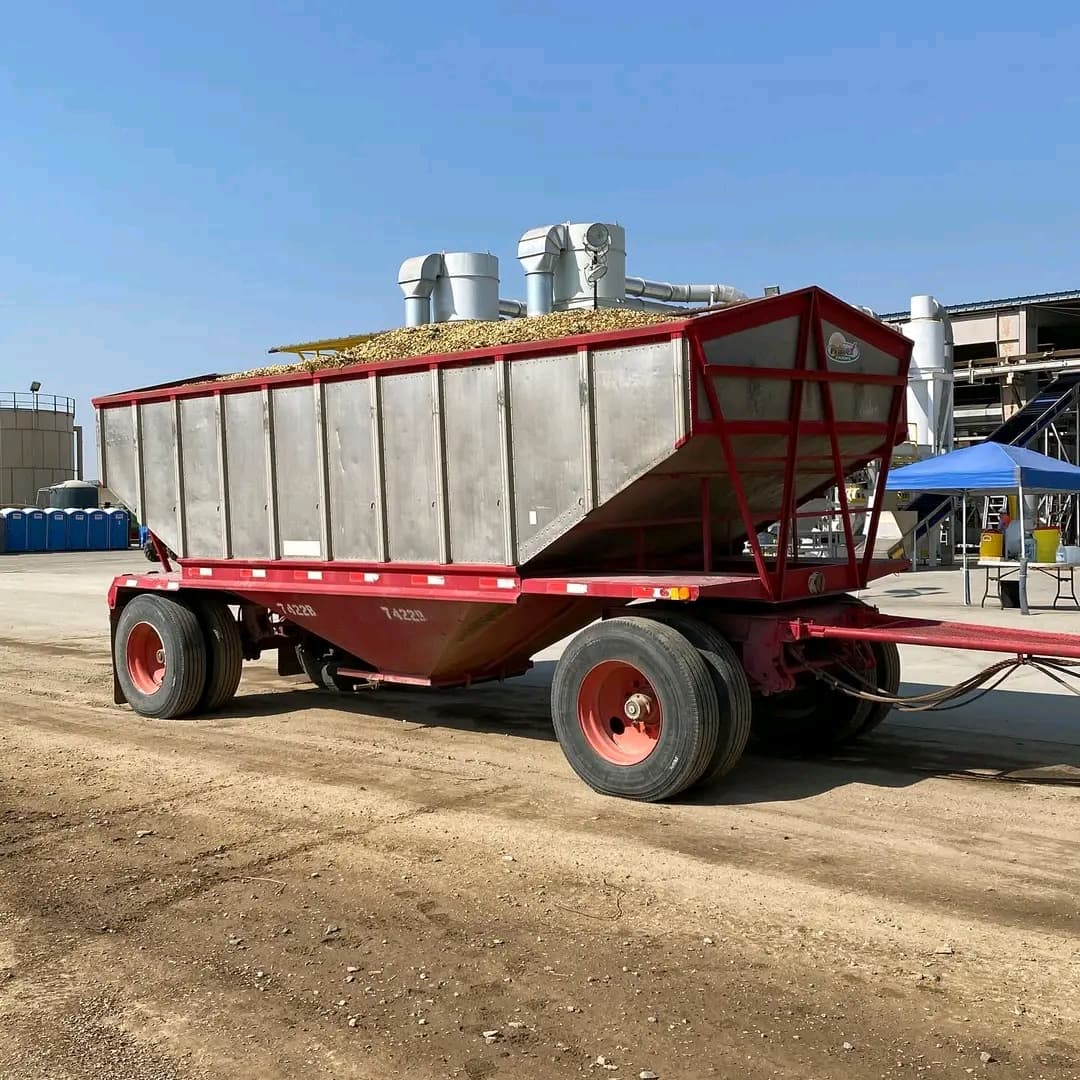
After shaking, the dislodged nuts fall to the orchard floor in a loose scatter pattern around the tree trunk, then are consolidated into windrows by a Savage Engineering pull-behind sweeper implement — a rotating brush system that gently pushes nuts toward the center of the tree middles while minimizing soil pick-up. The windrow machine follows the shaker by 90–120 minutes to allow any remaining surface moisture on the nuts from early-morning dew to evaporate before consolidation, reducing the risk of mold initiation in the windrow. The windrow pickup machine — a self-propelled elevator with a pickup header — then follows to lift the windrow nuts off the floor and convey them by elevator belt into 900 kg bulk bins staged on the machine's integral hoist system.
Timing between shaking and binning is a critical food safety control point. USDA pistachio processing regulations and California Pistachio Research Board guidelines both specify that a maximum of eight hours should elapse between when nuts hit the ground and when they are binned and in transport to the huller, because Navel Orangeworm adults are highly attracted to exposed, split pistachio shells on warm harvest days, and every hour of exposure increases the probability of adult oviposition — an event that leads to larval damage, aflatoxin-favorable microenvironments, and kernel quality degradation. Primex Farms' harvest operations are designed and sequenced so that no nut lies on the orchard floor for more than five hours under any circumstances, a standard that requires precise coordination of shaker, sweeper, and pickup schedules on multi-block harvest days.
Post-harvest sanitation of the orchard floor is an often overlooked but agronomically important step. After harvest is complete in each block, our crew uses a combination of disc cultivation and leaf blower equipment to incorporate remaining nut mummies, hull fragments, and leaf litter into the soil surface. This incorporation is a critical Navel Orangeworm management step, because mummified unharvested nuts remaining on the orchard floor or hanging on trees as 'stick-tights' serve as overwintering habitat for NOW pupae, exponentially increasing the pest population pressure in the following season. California Pistachio Research Board guidelines target the removal or incorporation of 95% of stick-tight mummies by December 31 of the harvest year; Primex Farms typically achieves >97% mummy sanitation as documented by our post-harvest block walk sampling protocol.