

Global Export
From California's Central Valley to dinner tables across four continents — Primex Farms is a trusted wholesale and export partner to the world's finest pistachio markets.
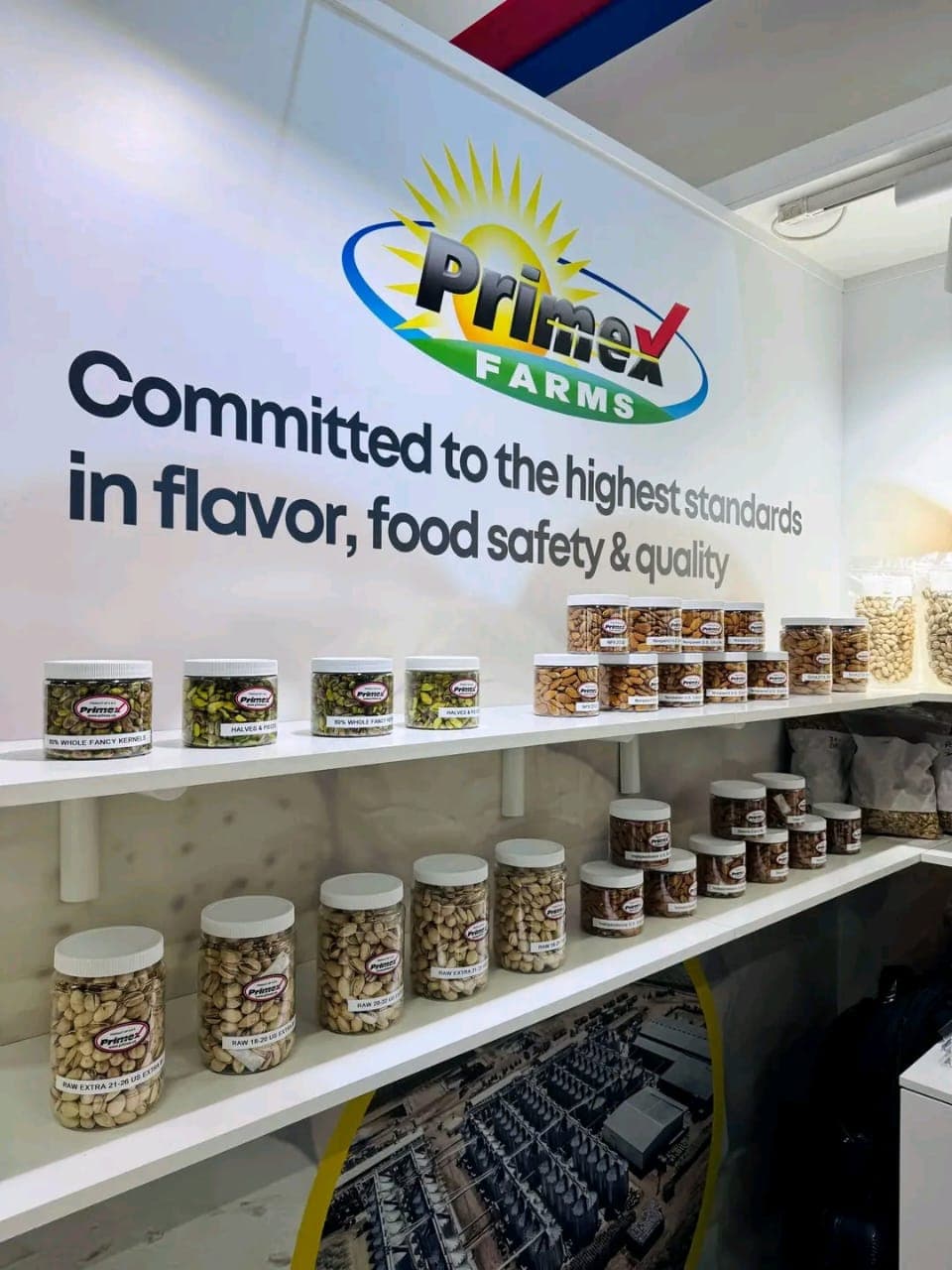
A Trusted Wholesale
Partner, Globally
Primex Farms exports premium-grade pistachios directly to importers, distributors, food manufacturers, and retailers across Asia, Europe, the Middle East, and the Americas. Operating in close proximity to major California cargo ports—primarily the Port of Oakland and the Port of Long Beach—we ensure fast transit times from facility floor to cargo vessel.
For shipments destined for international markets with strict pest control regulations (such as Japan or the European Union), we coordinate specialized in-transit cold treatment protocols. Our logistics team loads products into refrigerated (reefer) containers calibrated to precise temperature parameters and equipped with digital data loggers, verifying temperature stability throughout the entire ocean voyage.
We handle the complete documentation suite required for rapid customs clearance. This includes coordinating inspections with the USDA to obtain federal Phytosanitary Certificates, drafting detailed Certificates of Origin to leverage trade agreements, and issuing Certificates of Analysis (COAs) from certified laboratories proving that the cargo complies with target market tolerances.
Our export programs are supported by full documentation and containerized shipping coordination from our Wasco facility direct to port.
End-to-End Export Capabilities
Bulk Container Shipping
20ft & 40ft reefer and ambient FCL containers dispatched directly from our Wasco warehouse to any major world port.
Documentation & Compliance
Full USDA Phytosanitary, FDA Prior Notice, Certificate of Origin, and Kosher/Halal certification support.
Logistics Coordination
We manage inland trucking to Long Beach or Stockton port, freight forwarding, and customs brokerage partnerships.
Importer Partnerships
Long-term supply agreements with preferred pricing, reserved harvest allocations, and dedicated account managers.
Our Export Markets
East Asia
- China
- Japan
- South Korea
- Taiwan
Middle East
- UAE
- Saudi Arabia
- Qatar
- Kuwait
Europe
- Germany
- Netherlands
- UK
- Spain
North America
- USA
- Canada
- Mexico
Export Certifications & Compliance
Market-Specific Import Requirements & Incoterms
Navigating international import regulations is one of the most complex aspects of agricultural export, and Primex Farms has built deep institutional knowledge of the specific requirements of our major destination markets. Each importing country maintains its own set of phytosanitary import requirements — the conditions that product must meet to be admitted through the country's border inspection points — as well as food safety standards, labeling regulations, and customs documentation requirements. Our export logistics team maintains a living reference database of current import requirements for 22 active or prospective market countries, updated whenever we receive regulatory change notifications from our in-country import agents or from USDA Foreign Agricultural Service GAIN (Global Agricultural Information Network) reports.
The European Union is our most demanding and most documentation-intensive export market. EU pistachio imports from the United States are governed by Commission Regulation (EC) No 1881/2006 (aflatoxin limits), the EU General Food Law (Regulation EC 178/2002), and the EU Official Controls Regulation (Regulation EU 2017/625). EU border inspection posts (BIPs) typically perform identity checks on 100% of nut shipments and physical/laboratory checks on 20–50% of shipments, requiring that each lot be accompanied by a Certificate of Analysis showing total aflatoxin below 4 ppb, a CDFA phytosanitary certificate, and a declaration of conformity with EU pesticide MRL standards. Fumigation with methyl bromide — historically used for stored-product insect pest control — is prohibited for product entering the EU, so Primex Farms uses phosphine fumigation (under vacuum protocol) or cold-treatment as alternative post-harvest treatments for EU-bound shipments where fumigation is required.
For shipments to China — our fastest-growing export destination — Primex Farms operates under the China GACC (General Administration of Customs China) registration system, which requires that all US pistachio facilities registered to export to China be registered with GACC and audited against Chinese food safety standards. Our facility is currently GACC-registered under registration number [held on file], and we maintain compliance with GACC requirements including Chinese language labeling on all export cartons, Chinese import permit documentation (the '入境货物检验检疫证明' Inspection Certificate), and GACC-compliant aflatoxin limits ≤5 μg/kg and pesticide residue compliance with GB 2763. Chinese buyers are particularly sensitive to shell color — preferring uniformly ivory-white shells without staining — and to kernel greenness — a visual indicator of antioxidant content and freshness that commands price premiums in Chinese specialty food retail channels.
Japan represents a premium market where Primex Farms' product must comply with Japanese Ministry of Health, Labour and Welfare (MHLW) food safety standards — among the most stringent in the world — including positive-list pesticide MRL requirements that cover over 700 active ingredients and set limits as low as 0.01 ppm for substances without a specific MRL (the 'blanket limit'). Our Japanese market pesticide testing protocol uses MHLW-method multi-residue analysis by LC-MS/MS and GC-MS, performed at a qualified Japanese-registered laboratory on every lot destined for the Japanese market. Japanese retail buyers also require Japanese-language nutrition labeling compliant with the Food Labeling Act, lot traceability documentation in Japanese, and product that meets Japan's specific moisture and appearance standards — all documentation that our export team prepares and manages internally.
Understanding Incoterms — the International Chamber of Commerce's standardized trade terms that define the division of responsibility, risk, and cost between buyer and seller in international transactions — is essential for navigating pistachio export. Primex Farms offers product on multiple Incoterms bases depending on the buyer's logistics infrastructure and preference. For buyers with established freight forwarding relationships who prefer to manage their own shipping, we offer EXW (Ex Works, Wasco CA), where the buyer arranges all transportation from our facility gate. For buyers who prefer a CIF (Cost, Insurance, and Freight) basis, our export team handles freight booking through our preferred ocean freight carrier contracts, marine cargo insurance placement through a licensed broker, and all origin-country export documentation. We regularly ship FCL (Full Container Load, 20-foot or 40-foot dry container) and LCL (Less than Container Load) shipments; FCL 20-foot containers typically hold 24–26 metric tons of in-shell pistachios in bulk bins, while 40-foot containers hold 44–48 metric tons, and LCL options are available for smaller trial orders down to 1,000 kg minimum.
Refrigerated container (reefer) shipments are available for buyers requiring extended shelf life for natural in-shell product on long transit routes — particularly for Southeast Asian destinations with 28–35 day ocean transit times. Reefer containers are set at 32–34°F with 90% relative humidity, conditions that suppress respiration, mold growth, and oxidative quality degradation in natural pistachios to a degree that allows 18-month shelf life from production date — significantly longer than the 12 months achievable at ambient conditions. The cost premium of reefer over dry container shipping is typically $800–1,400 per container depending on the trade lane, an investment that buyers in premium retail markets often find worthwhile given the quality preservation benefit and the reduction in buyer-side rejection risk from quality degradation in transit.
Trade Finance & Long-Term Supply Agreements
Primex Farms accepts several payment methods for international transactions, structured to balance payment security for us with manageable financial terms for our buyers. For new trading relationships, our standard payment requirement is 30% deposit upon purchase order confirmation and 70% balance against a copy of the Bill of Lading emailed within 3 business days of container loading — a structure that provides us assurance of buyer commitment while giving the buyer proof of shipment before final payment. For established accounts with a track record of 12+ months of on-time payment, we may extend open-account (Net 30 from B/L date) terms or accept Letters of Credit at Sight (LC at Sight) from issuing banks with acceptable credit ratings.
Letters of Credit are particularly important for export transactions where Primex Farms has limited ability to assess the financial standing of the buyer's business — a common situation in first-time transactions with buyers in emerging market countries. An LC issued by a reputable confirming bank (we maintain relationships with issuing bank correspondent agreements through Wells Fargo Trade Capital's international trade group and Bank of the West) guarantees payment to Primex Farms upon presentation of the documents specified in the LC terms: typically the original Bill of Lading, commercial invoice, packing list, phytosanitary certificate, certificate of origin, and certificate of analysis. Our export documentation team is experienced in preparing clean LC document sets and reviews all LC terms carefully before acceptance to ensure that our processing capabilities can satisfy the specified documentation requirements within the stipulated shipping windows.
For buyers interested in annual supply agreements, Primex Farms' preferred structure is a 12-month rolling agreement specifying total volume commitment (in metric tons), minimum and maximum monthly delivery quantities, price formula (typically tied to a USDA Agricultural Marketing Service pistachio price survey benchmark plus or minus a negotiated differential), product specification, packaging format, and shipping terms. These agreements provide mutual benefits: buyers secure supply continuity and price predictability across a full crop season, while Primex Farms gains the forward demand visibility needed to plan crop allocation, processing scheduling, and logistics booking well in advance. Volume premiums — incremental price discounts for buyers committing above threshold annual volumes — are negotiated bilaterally and structured to reward buyers who help Primex Farms achieve efficient logistics consolidation.
Customs and tariff considerations are an important aspect of pistachio export economics. US pistachios are classified under HS Code 0802.51 (in-shell) or 0802.52 (shelled/kernels) in the Harmonized System used globally. Tariff rates on US pistachios vary significantly by destination market: EU member states impose a 2.4% standard import duty on pistachios from the US under the EU's Combined Nomenclature, which is a modest tariff that has historically made California pistachios cost-competitive with Iranian pistachios (subject to US sanctions trade restrictions) in the EU market. China's pistachio import tariff on most-favored-nation (MFN) basis is 15% for in-shell and 25% for shelled product — rates that have fluctuated in the context of US-China trade tensions and that our export team monitors continuously, as tariff changes can significantly affect our pricing competitiveness relative to Iranian and Turkish suppliers in the Chinese market.
Currency risk management is a factor that Primex Farms considers carefully for large forward-priced supply agreements denominated in foreign currencies. While the majority of our international transactions are invoiced in US dollars — reducing our direct exchange rate exposure — buyers in some markets prefer EUR or AED invoicing, and in those cases we use forward currency contracts through our bank to lock in exchange rates at the time of contract signing, ensuring that the USD-equivalent revenue we receive matches our budgeted expectations regardless of currency movements between contract date and payment date. For high-volume, multi-shipment contracts with EU buyers invoiced in Euros, we may hedge up to 80% of the contracted invoice amounts using 3–6 month forward EUR/USD contracts.
Logistics optimization for our export business is an ongoing focus. Primex Farms works with a select group of licensed US customs brokers and NVOCC (Non-Vessel Operating Common Carrier) freight forwarders who specialize in agricultural commodity exports from California, consolidating our regular container bookings onto preferred carrier services that offer consistent transit times, temperature monitoring (for reefer shipments), and competitive freight rates secured under volume contracts. Our logistics partners maintain electronic integration with our order management system, allowing automated generation of export documentation packages — commercial invoices, packing lists, shippers' export declarations (EEI filings in AES), and bill of lading instructions — that reduce manual documentation errors and accelerate customs clearance at destination ports. We aim to have all export documentation packages complete and transmitted to the freight forwarder within 24 hours of container loading, meeting the advance cargo information requirements of most importing countries' customs pre-arrival programs.